Style advice usually ignores the three things that actually decide how a Singapore flat looks once you live in it: very bright, very warm daylight, humidity around 80%, and rooms that are compact with a lot of doors.
A style that handles those conditions ages beautifully here. One that ignores them looks tired within two years. Here are six that work, why they work, and what each costs to do properly.
1. Warm minimalism, or Japandi
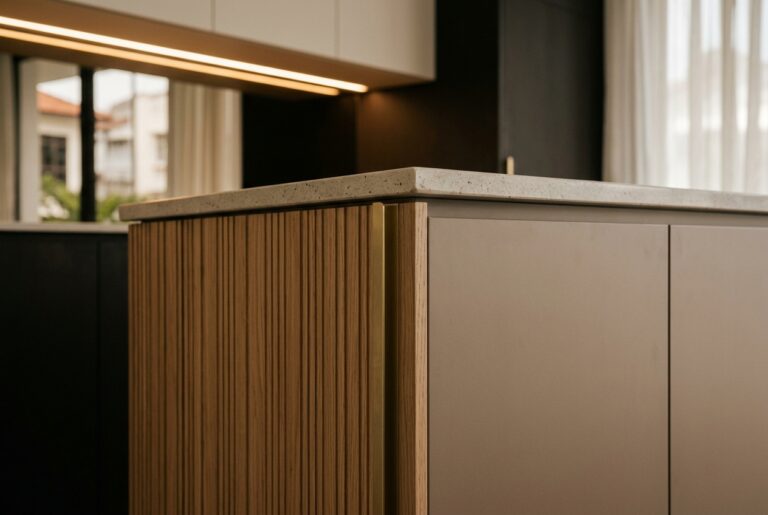
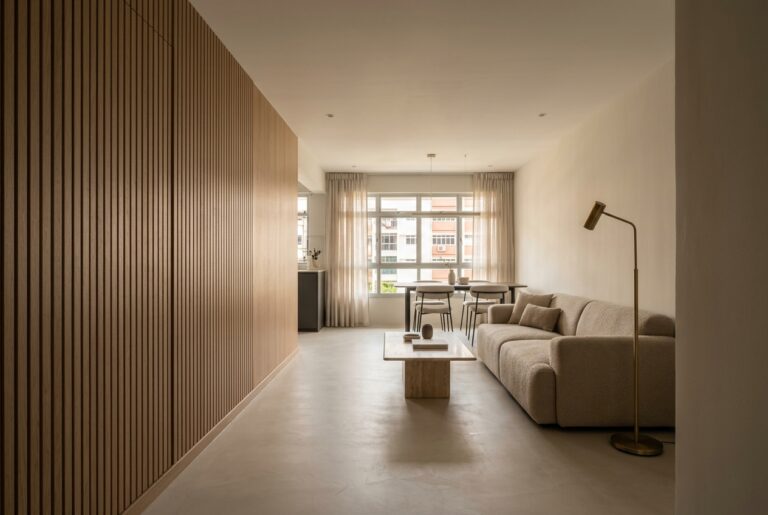
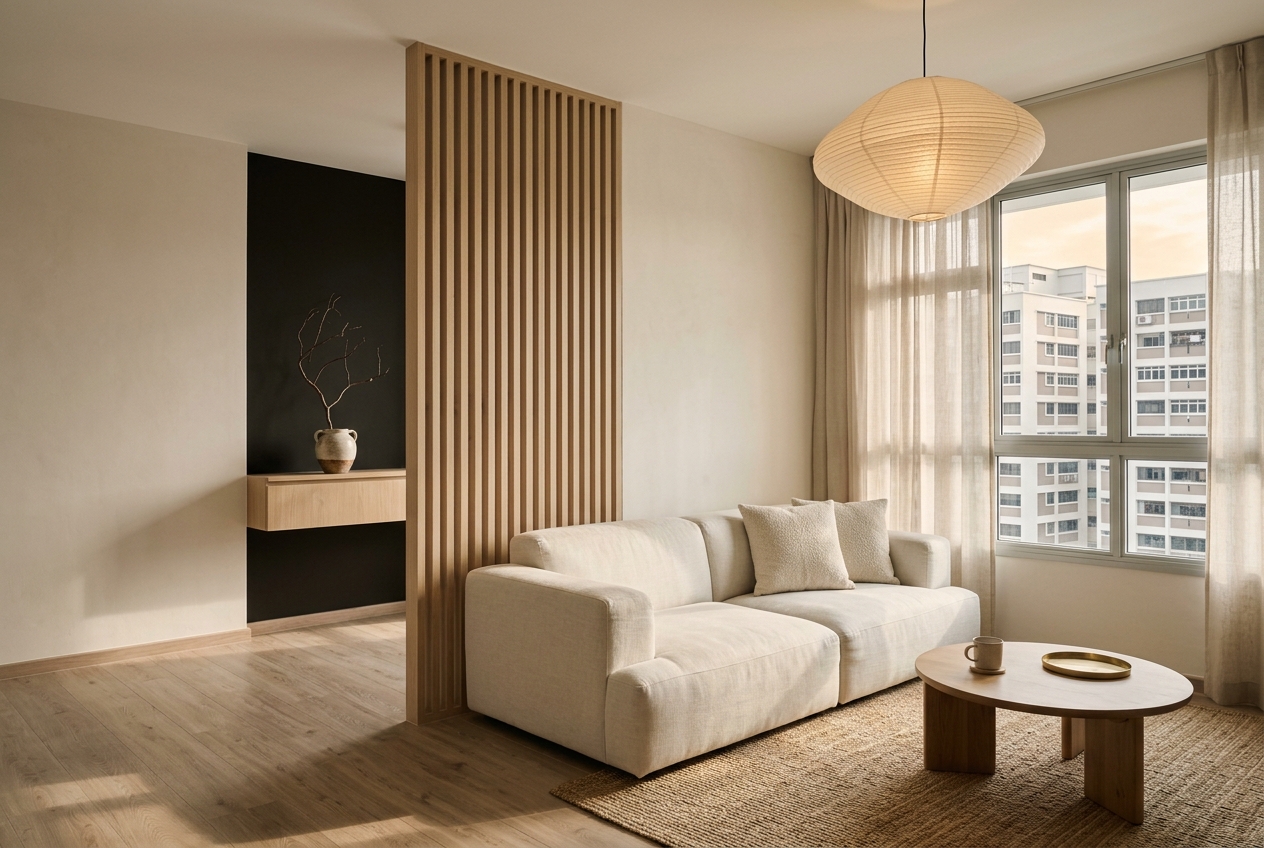
Pale oak, off-white walls, linen textures, low furniture, very little on display. The most requested register in Singapore right now, and for good reason: it makes compact rooms feel larger, it takes hard tropical daylight without glare, and the warm woods stop it reading as clinical.
Why it suits a flat: uninterrupted surfaces make a 90 square metre plan feel continuous. Low furniture raises the apparent ceiling. Warm neutrals are forgiving of the yellow cast of afternoon light.
What it costs: deceptively, this is not the cheap option. Minimalism has nowhere to hide, so it needs precise joinery, generous concealed storage, and good shadow-gap detailing. Expect a mid to upper budget.
How it fails: when the storage is under-provided. A minimal flat with nowhere to put anything becomes a cluttered flat within a month.
2. Contemporary modern
Clean lines, handleless cabinetry, a restrained palette with one strong accent, integrated appliances and layered lighting. The safest choice for resale value and the easiest to live with.
Why it suits a flat: handleless fronts remove visual noise in tight circulation. A single accent, a stone, a deep green, a brass, gives the flat identity without committing to a trend.
What it costs: mid budget, and it scales well. You can do a great deal of it in laminate.
How it fails: when the accent is applied everywhere. One accent, used three times, reads as intentional. Used eleven times, it reads as a showroom.
3. Modern tropical
Rattan and cane, timber, plants, natural fibre rugs, ceiling fans done well, and a palette taken from outside the window. The style most native to where we actually live.
Why it suits a flat: it is designed for heat and humidity. Open weaves, breathable materials and lighter furniture all read as cooler, and it makes a small balcony or service yard feel like part of the home.
What it costs: low to mid, because much of the character comes from loose furnishing rather than joinery.
How it fails: when natural materials go into wet areas. Cane near a shower and untreated timber in a kitchen will not survive Singapore humidity.
4. Muted industrial
The softened version: micro-cement or screed-effect surfaces, black metal frames, exposed ceiling in one zone only, warm wood to balance it. Not the raw brick and bare conduit version, which fights the scale of a flat.
Why it suits a flat: leaving the ceiling exposed in the living zone alone can buy 200 to 300mm of apparent height, which is a lot in a flat. Black-framed glass partitions divide space without blocking light.
What it costs: mid. Cement-effect finishes and custom metalwork are not cheap, and exposed services need to be neatly resolved rather than simply left.
How it fails: when it is applied to the whole flat. Bedrooms want warmth. Industrial in a bedroom reads as unfinished.
5. Classic contemporary
Restrained panelling, cornices used sparingly, a considered palette, quality ironmongery. The style that ages best, and the one most often done badly.
Why it suits a flat: vertical panelling genuinely lifts a 2.6m ceiling, and the proportion discipline of classical detailing suits rooms with a lot of doors.
What it costs: upper mid to high. Panelling is carpentry, and doing it in proportion takes drawing work.
How it fails: when the mouldings are oversized. In a flat, everything classical needs to be scaled down, not applied at the size it comes in.
6. Colour-led modern
A confident cabinetry colour, a deep green, an oxblood, a clay, against neutral walls and warm wood. Increasingly popular, and the most personal of the six.
Why it suits a flat: colour costs nothing extra in laminate, and one strong kitchen colour can carry an entire flat without a single feature wall.
What it costs: the same as contemporary modern. Colour is free; it is the finish that costs.
How it fails: when the colour is chosen from a screen. Look at the physical sample, in the flat, at the hour you are usually home.
The three-material rule. Pick one wood, one stone or stone-effect, and one metal, and use them throughout the flat. Almost every home that looks incoherent has five woods and three metals in it. Almost every home that looks expensive has three materials, used consistently.
What does not work well here, and why
- Heavy dark schemes across a whole flat. A dark palette can be magnificent in one zone with strong layered lighting. Applied to every room in a compact plan with a single ceiling light, it just reads dim.
- Full glossy white everything. Under hard tropical light, high-gloss white shows every fingerprint and every dust film, and the glare is genuinely uncomfortable in a west-facing living room.
- Ornate maximalism. Not because it is unattractive, but because pattern needs distance to be read, and flats do not have it.
- Untreated natural materials in wet zones. Humidity here is not a design constraint you can style your way around.
Four decisions that matter more than style
- Lighting layers. Ambient, task and accent. A flat with three lighting layers looks better in any style than a flat with one, in any other.
- Storage volume. Measure what you own before you design where it goes. Every style collapses under clutter.
- Sightlines. Stand at the front door. What you see from there sets the impression of the entire home, and it is usually not designed at all.
- Consistent hardware. One handle profile, one finish, throughout. It is the cheapest coherence you can buy.
Material palettes that work, by style
Three materials, chosen once, used everywhere. Here is a starting palette for each register.
| Style | Wood | Stone or stone-effect | Metal | Wall |
|---|---|---|---|---|
| Warm minimalism | Pale oak, light grain | Warm white quartz or travertine-effect | Brushed brass | Off-white, low sheen |
| Contemporary modern | Walnut or smoked oak | Veined quartz, soft grey | Matte black or brushed nickel | Warm grey or greige |
| Modern tropical | Teak-toned timber, rattan | Terrazzo or honed granite-effect | Antique brass | Chalky white or soft sand |
| Muted industrial | Dark oak | Micro-cement or screed-effect | Matte black steel | Cement-effect on one plane only |
| Classic contemporary | Mid oak or painted timber | Marble-effect quartz | Polished nickel or aged brass | Soft neutral with panelling |
| Colour-led modern | Light oak as the neutral | Plain quartz, no veining | Brass or black, one only | Warm white to let the colour lead |
Lighting, specified per style
Lighting does more for a style than any finish, and it is decided at first fix, weeks before anything looks like anything.
- Warm minimalism: concealed cove for ambient, minimal downlights, 2700K to 3000K throughout. Avoid a grid of spots.
- Contemporary modern: a mix of recessed spots on the perimeter and one sculptural pendant over the dining table.
- Modern tropical: warm, low and layered. Table and floor lamps rather than a bright ceiling.
- Muted industrial: track lighting in the exposed zone, warm temperature to keep it from reading cold.
- Classic contemporary: wall lights and a central fixture, with the cornice detail lit rather than washed out.
- Colour-led modern: neutral, high colour-rendering light so the colour you chose is the colour you see.
One rule for every style: keep the colour temperature consistent across the flat. A mix of 3000K and 4000K fittings in adjacent rooms is the most common reason a well designed home looks slightly wrong and nobody can say why.
Tactics for a compact flat, in any style
- Take joinery to the ceiling. The dust gap above a wardrobe is wasted volume and a visible horizontal line that shortens the room.
- Use one flooring material throughout. Changing floor finish at every doorway chops a small plan into smaller pieces.
- Choose low-backed furniture. It raises the apparent ceiling more reliably than any paint colour.
- Put the mirror where it reflects a window, not where it reflects a wall.
- Design the entry. Somewhere to put keys, shoes and a bag within a metre of the door prevents the rest of the flat from absorbing them.
- Hide the doors. Painting doors and frames the same colour as the wall makes a corridor read as a surface rather than a series of interruptions.
What each style costs, roughly
For a 4-room flat, using the same carpentry length and comparing like for like.
| Style | Relative budget | Where the money goes |
|---|---|---|
| Modern tropical | Lowest | Loose furnishing, textiles, plants. Minimal built-in work. |
| Colour-led modern | Low to mid | Laminate colour is free; spend is standard carpentry. |
| Contemporary modern | Mid | Handleless detailing, integrated appliances, lighting. |
| Muted industrial | Mid to upper | Cement-effect finishes, custom metalwork, neat exposed services. |
| Warm minimalism | Upper | Precise joinery, concealed storage, shadow gaps, no room for error. |
| Classic contemporary | Upper | Panelling is carpentry, and proportion takes drawing time. |
Common questions
Which style is cheapest to execute well?
Modern tropical, because most of the character sits in loose furnishing rather than built-in joinery. Warm minimalism is the most expensive to do convincingly, despite looking like the simplest.
Will a bold style hurt resale value?
Colour in cabinetry is easy for the next owner to live with or change. What is hard to undo is an unusual layout or heavily themed built-in joinery. Be adventurous with colour, conservative with structure.
Can I mix two styles?
Yes, and most good homes do. The way to make it work is to let one style set the architecture, the joinery, finishes and lighting, and let the second appear only in loose furniture and textiles.
Does style affect the renovation cost much?
Less than people expect. The budget is driven by how much is built in, the finish grade and whether anything wet moves. Two very different styles at the same carpentry length and finish cost roughly the same.
The summary
Choose a style that handles hard daylight, humidity and compact rooms, hold to three materials, layer the lighting, and design the storage before the aesthetic. Do those four things and almost any of the six styles above will look considered ten years from now.
Figures in this article are Singapore market ranges as at August 2026 and are not a quotation. Verify HDB requirements against HDB’s own renovation guidelines before committing to any scope.