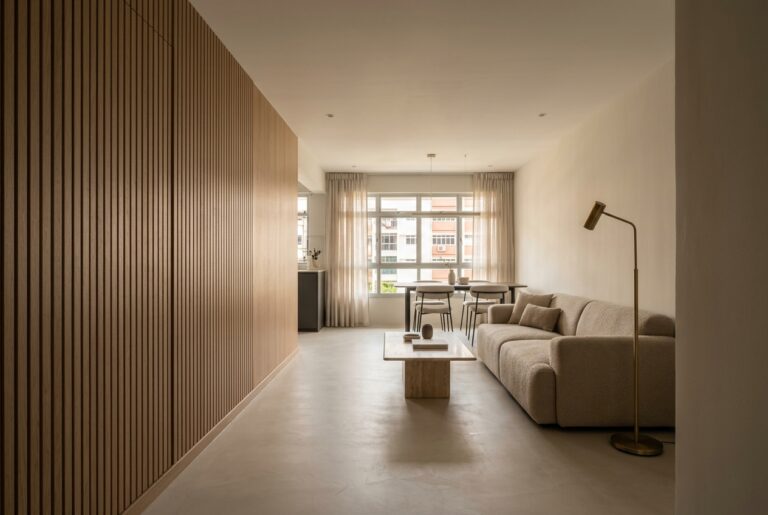
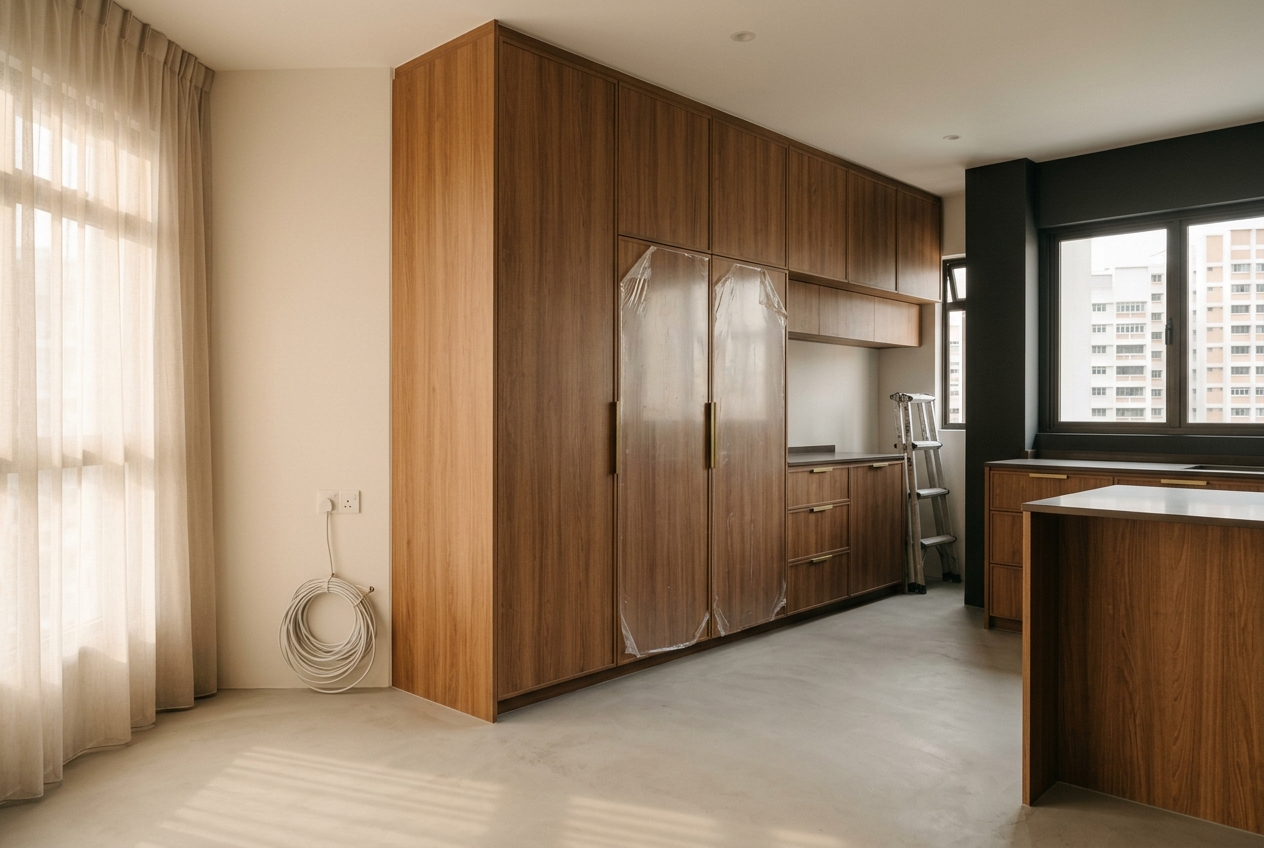
The number most people are quoted is eight to twelve weeks, and for the site works alone that is broadly right. The number that actually governs your move-in date is longer, because design, permits, material lead times and the final defect round all sit outside that window.
From first consultation to sleeping in the flat, a realistic plan for a standard 4-room BTO is four to six months. Here is where every week goes.
The timeline at a glance
| Phase | Duration | Runs in parallel with |
|---|---|---|
| Design, specification and quotation | 4 to 6 weeks | Key collection, defects inspection |
| Permit application and approval | 2 to 4 weeks | Material selection, ordering |
| Demolition and hacking | Week 1 to 2 | Long-lead item production |
| Wet works, masonry and tiling | Week 2 to 5 | Carpentry fabrication off site |
| Electrical, plumbing and aircon first fix | Week 3 to 5 | Ceiling framing |
| Ceiling, partitions and plastering | Week 4 to 6 | |
| Painting | Week 6 to 8 | |
| Carpentry installation | Week 7 to 10 | |
| Second fix, glass, doors, sanitary ware | Week 9 to 11 | |
| Touch-up, cleaning and handover | Week 11 to 12 | |
| Defect rectification | 1 to 3 weeks after handover | Furniture delivery |
A light, no-hacking scope can finish in four to six weeks. An extensive one with wet works and full carpentry commonly runs ten to fourteen.
Before anyone touches the flat
Design and specification: 4 to 6 weeks
This is the phase people compress and then regret. It covers space planning, layout sign-off, elevations for every carpentry item, the materials schedule, the lighting plan and the electrical point plan. Every hour spent here removes several from the site programme, because a decision made on a drawing is free and the same decision made in week seven is not.
Permits: 2 to 4 weeks
Your contractor applies for the HDB renovation permit. Demolition cannot legally start before it is approved, so this sits on the critical path. Apply for it while material selection is still running rather than after.
Long-lead items: order early
The things that delay handover are rarely the tiles. They are the imported stone slab, the specific tap finish, the sliding door track, the made-to-order glass, and the appliance that turns out to be on a six-week backorder. Identify them in week one of design and order them the moment they are confirmed.
On site, week by week
Weeks 1 to 2: demolition and hacking
Existing finishes come out, permitted walls come down, and the flat gets noisy. This phase is constrained by HDB’s rules: noisy works such as heavy hacking and extensive demolition are permitted only between 9am and 5pm, Mondays to Fridays, and not on Sundays or public holidays. That is five short windows a week, which is why hacking-heavy scopes stretch.
Weeks 2 to 5: wet works, masonry and tiling
Screeding, waterproofing where applicable, wall and floor tiling, and any brickwork for new partitions. Tiling has curing time built into it, and rushing that is how you get hollow tiles and grout failure a year later.
Weeks 3 to 5: first fix services
Electrical points, data, plumbing runs and air-conditioning pipework are installed before anything is closed up. This is the last moment a socket can move for free, and the reason the electrical plan needs to be finalised in design rather than discovered on site.
Weeks 4 to 6: ceiling, partitions and plastering
False ceilings, cove details, bulkheads and any drywall partitions go in, then get skimmed and sanded. Dusty, and best kept well away from finished surfaces.
Weeks 6 to 8: painting
Sealer and two coats. Painting is scheduled before carpentry installation for a reason: cutting in around a fitted wardrobe is slower and never as clean.
Weeks 7 to 10: carpentry installation
The visible transformation, and the shortest-looking phase for the longest-running work, because the fabrication happened off site over the preceding weeks. This is why a carpentry change requested in week six is expensive: the material has already been cut.
Weeks 9 to 11: second fix and fittings
Switches and sockets faced off, light fittings hung, sanitary ware and mixers installed, glass and doors fitted, countertops templated and installed. Stone tops are usually measured after carpentry is standing, which adds a short but unavoidable gap.
Weeks 11 to 12: touch-up, clean and handover
Snagging, touch-up paint, adjustment of doors and drawers, and a full clean. Walk the flat with your designer or contractor and write the defect list down rather than describing it verbally.
Build a buffer, not an optimistic date. Add two weeks to whatever handover date you are given before you book movers, cancel a lease or schedule furniture delivery. Almost every renovation absorbs a fortnight somewhere, and the cost of finding out late is a month of hotel or storage.
What actually causes delays
- Late decisions. The single largest cause. Every unresolved item eventually blocks a trade.
- Changes after fabrication. Carpentry cut to a superseded drawing has to be remade.
- Material lead times. Especially imported stone, specialist glass and non-stock appliance finishes.
- Permit timing. Applied for late, it delays the very first phase.
- Trade sequencing. A missed handover between two trades can cost a week even when both are available.
- Public holiday clusters. Chinese New Year in particular removes site days and slows suppliers on both sides of it.
How to protect your timeline
- Finalise the layout and the electrical plan before site starts, and treat both as locked.
- Approve carpentry elevations item by item, in writing.
- Order long-lead items in the design phase, not the build phase.
- Agree a weekly site update and a single point of contact.
- Keep a written variation log so that changes to cost and to programme are visible when they happen.
- Book the movers only after handover has been achieved, not against a projected date.
What you should be doing during each phase
A renovation is not a spectator sport, but the useful contribution changes as it goes.
| Phase | Your job |
|---|---|
| Design | Decide. Layout, storage volumes, electrical positions, materials. This is the only phase where your input costs nothing. |
| Permit and ordering | Confirm long-lead selections: stone, tap finishes, appliance models, glass. |
| Hacking and wet works | Stay out of the way. Ask for progress photographs rather than visiting daily. |
| First fix | Walk the flat and stand where your furniture will go. This is the last free chance to move a socket. |
| Ceiling and painting | Approve paint colours on the actual wall, not on a card. |
| Carpentry installation | Check each item against its approved elevation as it goes in. |
| Second fix | Test everything. Every socket, every switch, every tap, every drawer. |
| Handover | Compile one written defect list with photographs. Do not report items one at a time. |
Before key collection: the four-week head start
Almost everything in the design phase can be done from the floor plan alone, which means the weeks before you collect keys are free programme if you use them.
- Shortlist and meet firms. Two or three is enough; five produces confusion rather than clarity.
- Set the budget and the contingency, and say both numbers out loud in the first meeting.
- Agree the layout in principle, including which walls you hope to remove, subject to confirmation on site.
- Start material direction. Bring physical samples home rather than screenshots.
- Measure your existing furniture and list what is coming with you.
- Count your storage honestly: shoes, luggage, bedding, seasonal items, tools. This is the most under-estimated number in every renovation.
Only site measurement, the permit application and confirmation of what is actually built need the keys in your hand.
Resale flats take longer, and here is why
A resale renovation typically runs three to five weeks longer than the equivalent BTO scope. The extra time is not carpentry, it is discovery.
- Demolition takes longer and generates far more debris, which means more disposal trips inside the same restricted noisy-works hours.
- Substrates are unknown. Uneven screed, previous waterproofing of unknown quality and legacy wiring all surface only once things are opened up.
- Making good is a real phase. Every removed cabinet leaves wall damage behind it.
- Occupancy overlap. If you are living there during works, the programme stretches around you.
Plan around the holiday clusters
Two periods reliably disrupt Singapore renovation programmes. Chinese New Year removes site days on both sides of the holiday and slows fabricators and suppliers for weeks around it. The year-end period compresses deliveries and imported material lead times. If your handover target lands within a month of either, add time deliberately rather than discovering it later.
What handover should actually include
- A full clean, including inside cabinetry and on top of wardrobes.
- A walkthrough with the person who coordinated the works, not a salesperson.
- Testing of every electrical point, tap, drain and drawer with you present.
- Keys for every lock, including any cabinet locks.
- Warranty documentation for carpentry, waterproofing and anything supplied.
- Touch-up paint left on site, labelled by room.
- An agreed date for defect rectification and a named contact for it.
Common questions
Can a BTO renovation be done in six weeks?
Yes, if there is no hacking, minimal wet works, and carpentry is limited and ordered early. It is a scope decision, not a scheduling trick.
Should I start design before collecting keys?
Yes. Layout planning, budgeting and material direction can all be done from the floor plan. Only site measurement and permit application need the keys.
Can I live in the flat during renovation?
For a BTO it is rarely practical or safe during hacking, wet works and painting. For a partial resale renovation it is sometimes possible if the works are zoned, but it slows the programme.
When do defects get fixed?
Usually within one to three weeks after handover. Compile one written list rather than reporting items one at a time, so the trades can return once instead of five times.
The summary
Eight to twelve weeks on site, four to six months end to end, and a fortnight of buffer on top. The projects that finish on time are almost never the ones with the fastest contractor. They are the ones where the decisions were made before the first wall came down.
Figures in this article are Singapore market ranges as at August 2026 and are not a quotation. Verify HDB requirements against HDB’s own renovation guidelines before committing to any scope.